The problem it solves
You have a few thousand connections. Some of them are the reason your next deal happens and most of them are not, and there is no view in LinkedIn that tells you which is which. So the work becomes a feeling — you message the people you happen to remember.
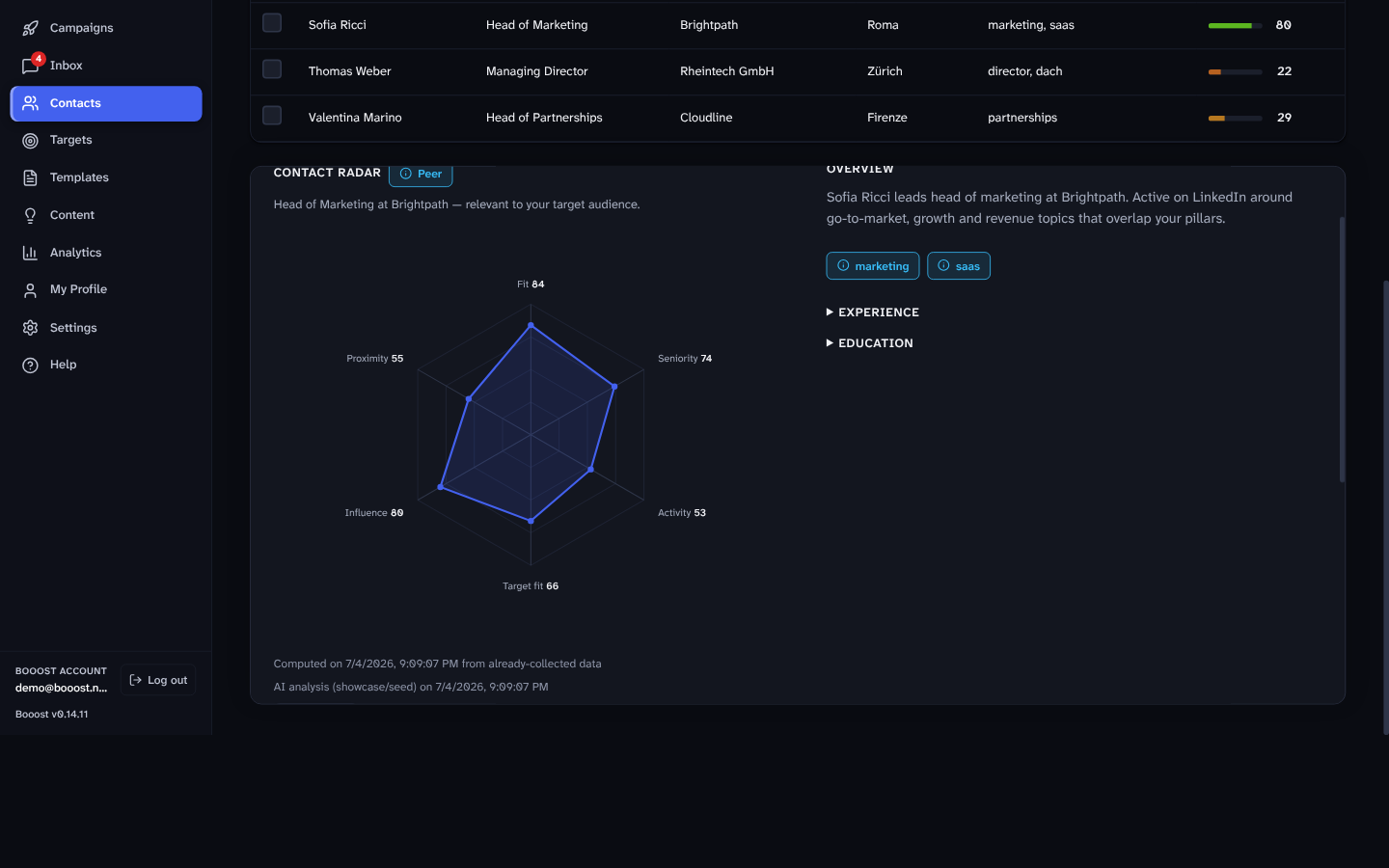
The radar replaces the feeling with six measured numbers, and then shows its working.
The six axes
| Axis | What it measures |
|---|---|
| Thematic fit | how close what they do is to what you sell or write about |
| Seniority | whether they can decide, influence, or only forward |
| Activity | whether they actually use LinkedIn, or have a dormant profile |
| Relationship | what has already happened between you — messages, reactions, comments |
| Influence | reach and standing in their own network |
| Proximity | how many steps away, and through whom |
Each axis is scored independently. Axes with no data stay empty rather than defaulting to a middle value — an unscored axis reads as unscored, not as average. The deterministic axes always land; the AI-assisted part of the analysis is stored and reused rather than recomputed, so the same contact does not drift between two different scores on two different days.
The evidence is the point
Under each score there are evidence lines: the specific facts that produced it. Stored language-neutral, so they read in your language, not in the language of the profile.
This exists because a score you cannot interrogate is a score you cannot act on. "84" means nothing. "84 — head of growth at a 200-person SaaS, posted 11 times in 30 days, reacted to two of your posts, second degree through someone you actually know" means you should probably write to them today.
It also means you can disagree. If the radar rates someone highly and you know they left that company last month, the evidence tells you which input is stale.
Hot, Warm, Nurture, Cold
The six axes collapse into one band, with the reasons kept:
| Band | Score | What it means in practice |
|---|---|---|
| Hot | 70+ | worth a personal message this week |
| Warm | 45–69 | worth engaging with before you ask for anything |
| Nurture | 25–44 | worth staying visible to, not worth a pitch |
| Cold | under 25 | leave alone |
The bands are what campaigns and the AI inbox target: you build a sequence for Warm contacts in fintech who have posted this month, not for a static list you exported once and that started decaying the same afternoon.
Where the data comes from
Your own network. The contacts your connected accounts already have, enriched from what LinkedIn shows those accounts. Booost does not sell you a lead database and does not scrape people you have no relationship with.
That is a real limitation and worth being clear about: if you are starting from an empty network, the radar has little to work with. It is a tool for making an existing network legible, not for manufacturing one.
⚠️ One flow that leaves your machine: the connection graph — the part that computes second-degree paths and who connects you to whom — is calculated on our servers. Everything else here lives in the local database. The full list is on the security page.
The network graph
Beyond the per-contact score, the same data draws the graph: who your accounts know, who those people know, and the shortest warm path to someone you want to reach. It is the difference between "we have no relationship with this company" and "two of your colleagues both know their VP of Sales".
People from your lists, on LinkedIn and on X
Booost reads who follows you and whom you follow — on LinkedIn, from "My Network", and on X, from the channel's own lists — into the same Contacts list, one row per person, off by default because it is other people's data. The tie sits next to the LinkedIn degree, one badge per channel: they follow you, you follow them, or both. On LinkedIn a follower who is already a contact is recognised by their LinkedIn id, so nothing is duplicated; when a person on X looks like one of your contacts, Booost proposes the match and you confirm it. From then on the radar reads every channel: a LinkedIn follow counts toward proximity even without a connection, and the posts read from X count toward activity and feed the analysis exactly like LinkedIn posts do. Proximity on X is a follow, not a degree; there is no second-degree path on X.
What it does not do
- It does not enrich strangers. No email-finding, no phone-number lookup, no third-party data vendor behind the scenes.
- It does not export to your CRM. There is import and export, but no live sync — Booost has no integrations today, by design and by omission both.
- It does not decide for you. Nothing is sent because of a score; the score orders your attention, a human still approves the action.
Which editions have it
Basic and Pro. The radar, the bands, the evidence and the graph are in both — this is not the AI-tier boundary. Community is publishing-only and has no contacts module at all.
Questions this page gets asked
Is the score recomputed constantly? No. Deterministic axes update as new data arrives; the AI-assisted analysis is stored and reused, which is what stops a contact drifting between scores day to day.
Can I change the weights? Not today. The bands and thresholds are fixed; the evidence lines are there so you can override the conclusion yourself.
Does it work across several accounts? Yes, and the analytics stay per account — an agency sees each client's network on its own terms rather than in one blended pile.
What if a contact's data is out of date? The evidence line shows you what it is based on, which is exactly when it is worth ignoring the number.